Artist · choreographer · curator
Konstantin Grouss
Moscow · Europe · USA, 2001–2022 · Ubud, Bali, since 2023

Konstantin Grouss. Photo by Irina Trushina
“
The poetry of the working process
Nothing can be born that has not been carried to term; such is the law. Every impression, every seed of a feeling must ripen to the end in itself, in the dark, in the unsayable, in the unconscious, in that region our reason cannot reach, and one must wait, humbly and patiently, for the hour when a new clarity comes: only so should an artist live. To be an artist means not to calculate, but to grow like a tree that does not hurry its sap and meets the spring storms without anxiety, without fear that summer may not follow. It will come. But it comes only to the patient, who live as though eternity lay before them — so untroubled, so quiet and so wide.
Nothing can be born that has not been carried to term; such is the law. Every impression, every seed of a feeling must ripen to the end in itself, in the dark, in the unsayable, in the unconscious, in that region our reason cannot reach, and one must wait, humbly and patiently, for the hour when a new clarity comes: only so should an artist live. To be an artist means not to calculate, but to grow like a tree that does not hurry its sap and meets the spring storms without anxiety, without fear that summer may not follow. It will come. But it comes only to the patient, who live as though eternity lay before them — so untroubled, so quiet and so wide.
The Question
How can potential become manifest without losing its freedom?
Konstantin Grouss has been asking one question in different materials since 2003.
He borrowed the term for it early, from Aristotle — entelechy, the movement from the possible to the actual — and the epigraph for his first piece from Dürer's Treatise on Proportions: "one form may take on another; the reasons for such a change are countless". That piece, Intuition of Form (2003), was dedicated "to everything that has not found form". Everything since has been the same question in another material.
Two Lines
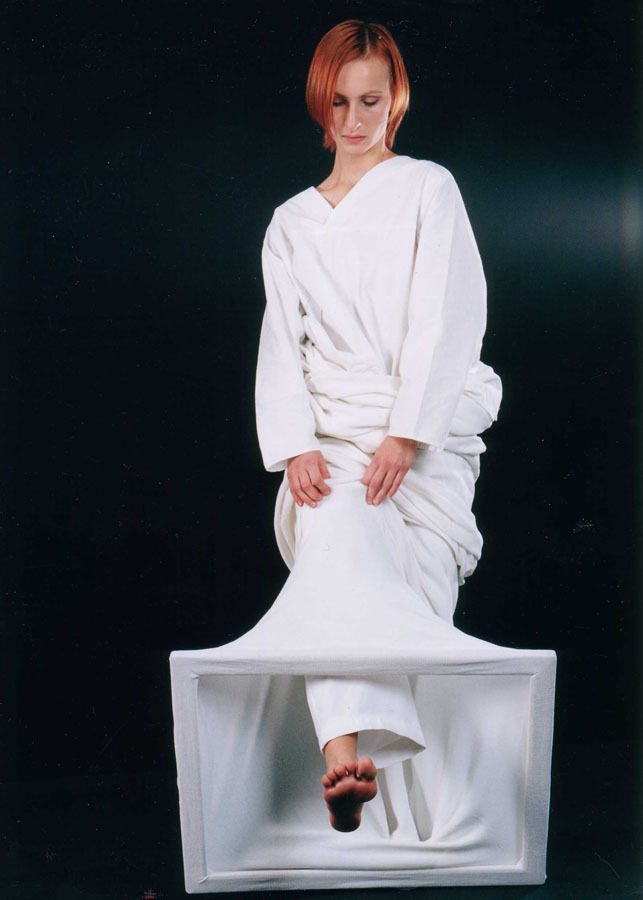
Two things run through the work. He calls one of them the sign — the hieroglyph: the compressed, readable trace a form leaves. The other is energy: the source a form comes out of, which is never fully spent by any particular form it takes.
For most of twenty years the two were braided together. In 2015 they separated: the sign went into sculpture, the energy stayed in dance as pure improvisation. In the work made in Bali they have joined again.
The Sign Photo by artist
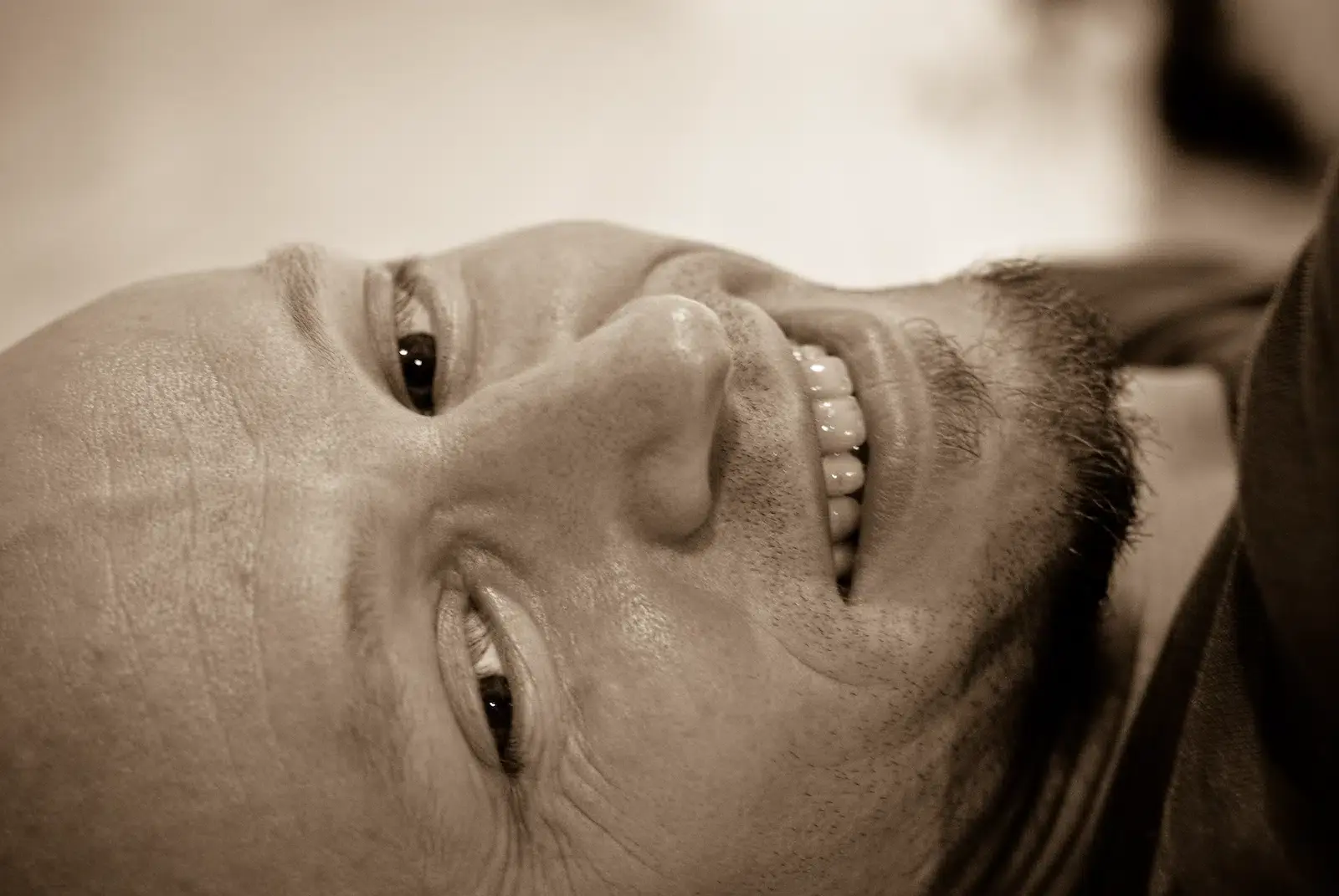
The Energy —
Photo by Irina Trushina
The Sign
The sign showed itself most clearly in the work with Alexei Lubimov's musical programmes, the first of which — Amores, to music by John Cage — was made in September 2004. A whole series of programmes followed: Bacchanale in the Garden of Stones, Four Walls in the Rachmaninov Hall, Cage for Air. The roots of the movement vocabulary, he has said, are in Joan Miró's compositions and in Cage's own musical notation: pictograms, a way of writing a form down rather than describing it. A critic reviewing him years later called the dancing hieroglyphic, and he agreed.
The sign kept reappearing. In Mask for Body (Pushkin State Museum of Fine Arts, 2006) the body used movement as a mask. In Notes (2010) choreography was made out of a linguistic symbol, for a festival whose subject was translation — and it was there that the work crossed out of dance and into contemporary art. In EASY-COME-EASY-GO<at>BODY<dot>MOVE, begun at the Garage Museum in 2014 and premiered at the State Theatre of Nations in 2018, a live news feed was read through the body by a motion sensor and converted back into sound: one sign turned into another, with the body as the processor.
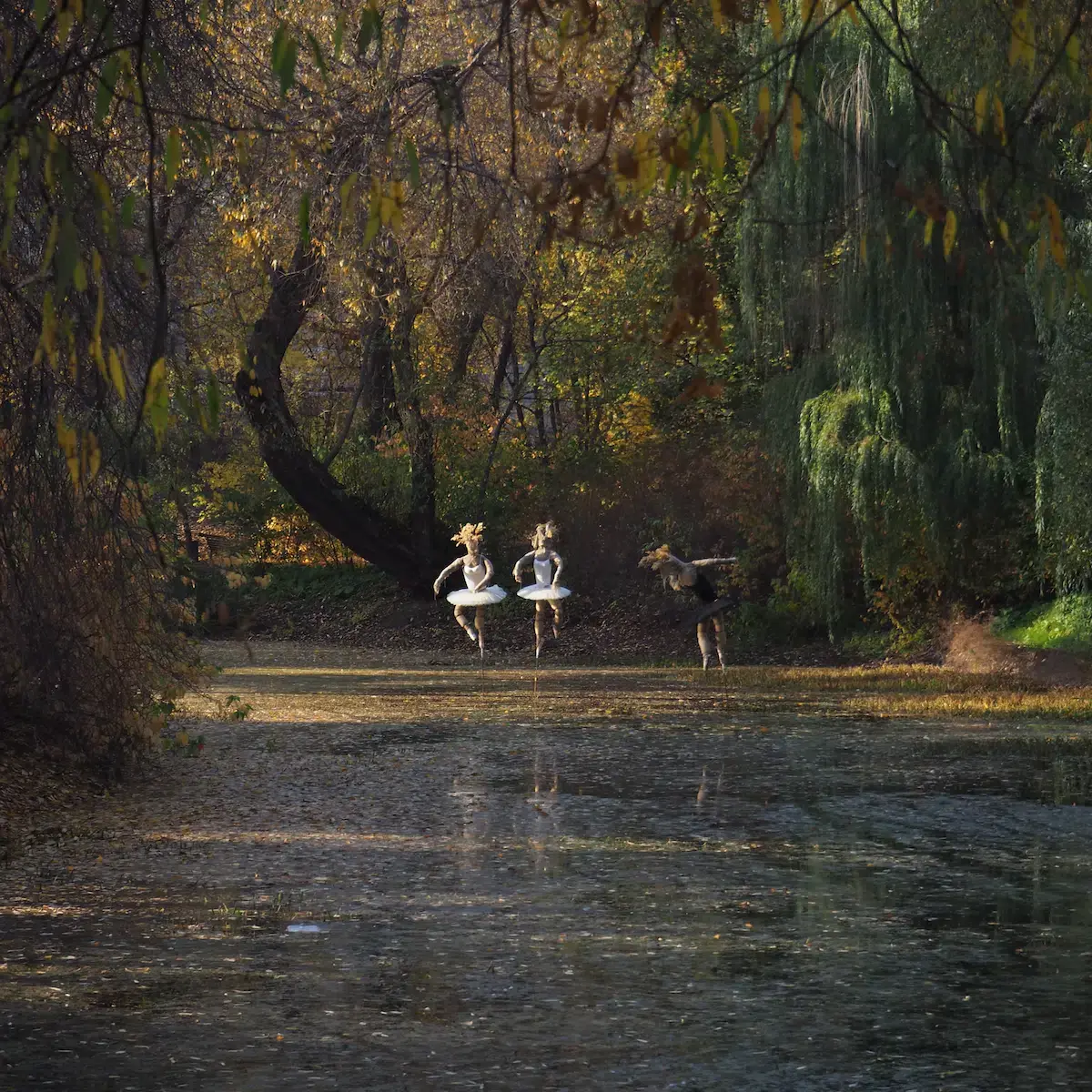
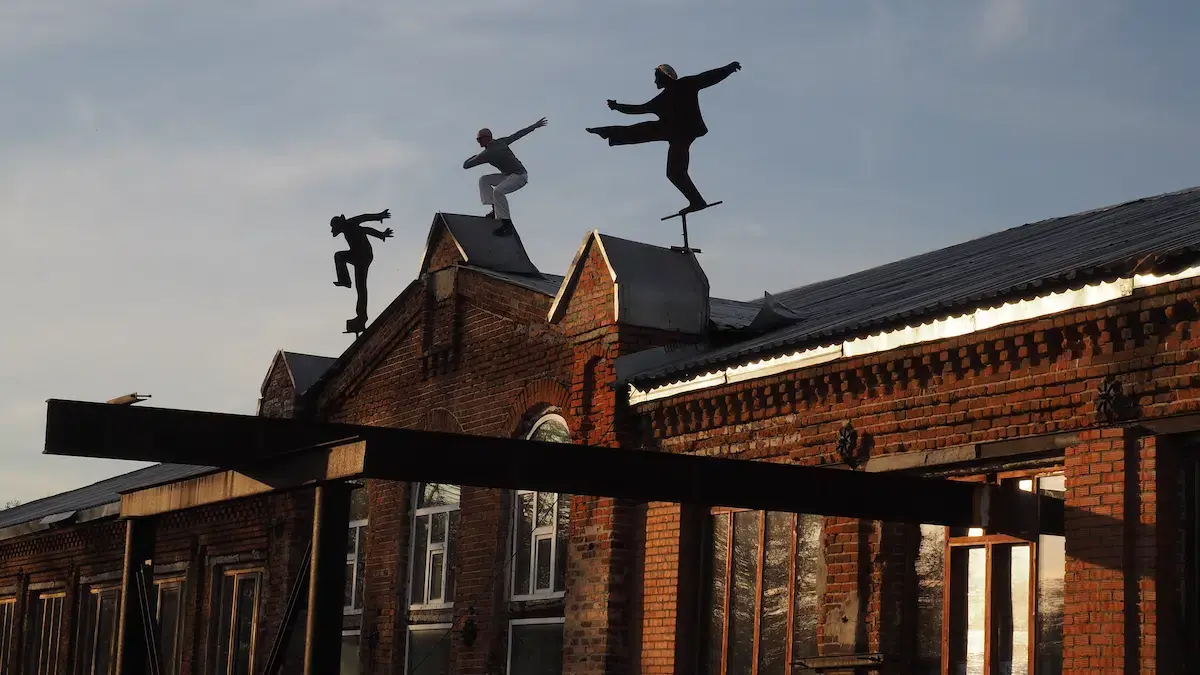
In The Swans Have Arrived! (2018), ballerinas built from scrap found in a botanical garden made a sign that played Tchaikovsky in the head of anyone who recognised it, and stayed scarecrows for everyone else — and the tutus they wore were real, given by the ballet-wear house Grishko. Standing beside them on the pond of the Apothecary Garden he called them "our homage to ballet": a choreographer's sentence about an object that cannot move. The sculpture turned out to be time-based anyway. The festival closed in August; the swans stayed on the water through the autumn and under the snow until the following spring, so that the piece anyone saw depended on the month they came. A work about stillness took a year to perform.
The Energy
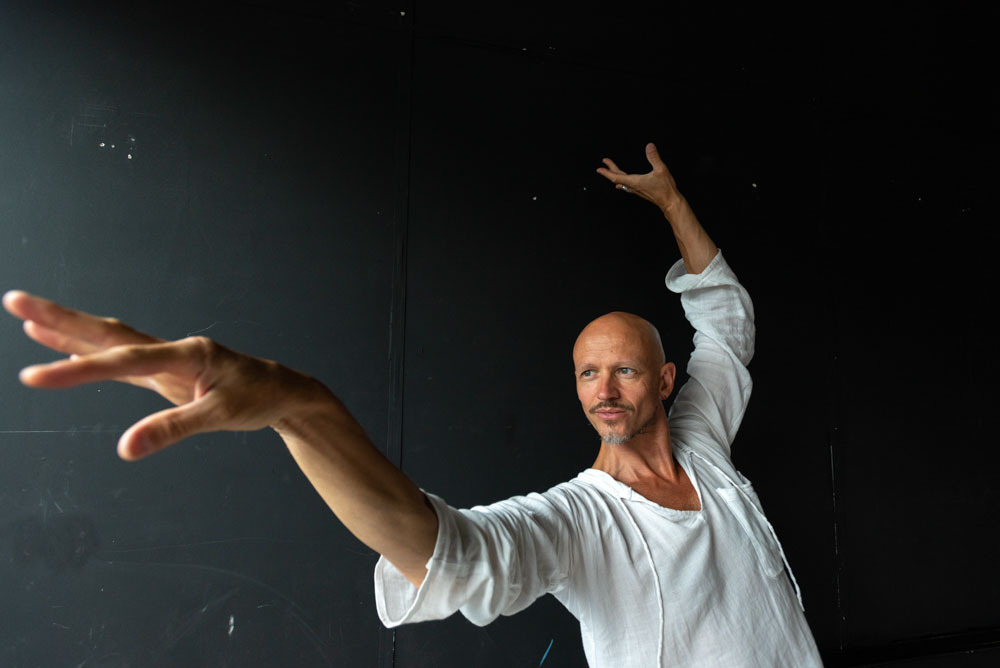
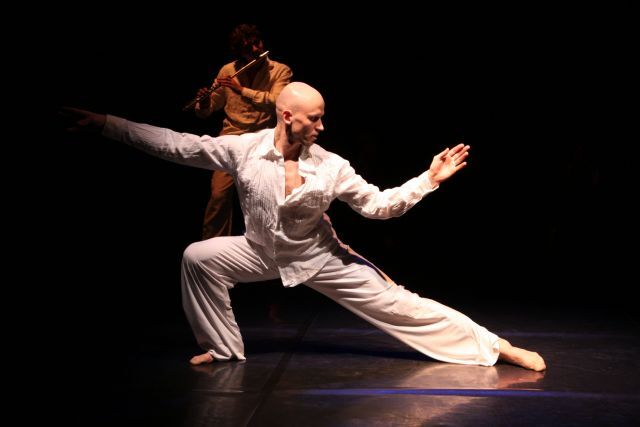
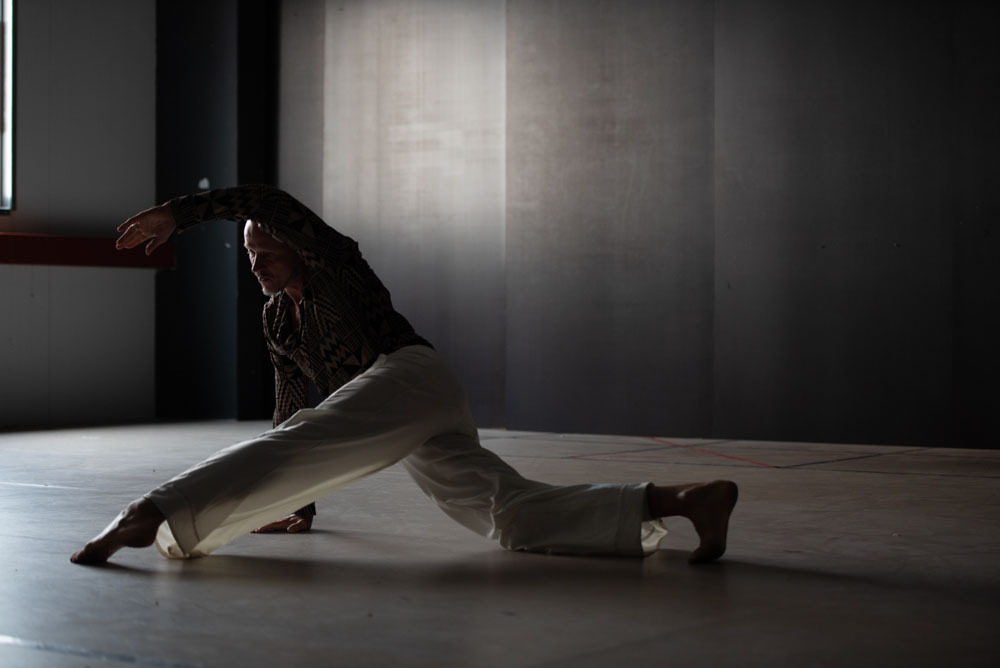
The other line is harder to photograph. It is what Info<at>body<dot>move (2013) was about: an address to the audience about a deep and unexplored source, then twenty-five minutes in which a thousand forms come out of it through the body without losing their connection to it — bounded not by a frame but by an alarm clock set to ring at the end. It is what Aheym (2019) was: improvised from beginning to end, unset, with the hieroglyph appearing only on the last note of the music and melting into silence. It is why he defines dance, in 2022, in three words: continuity, energy and rhythm.
Why a choreographer built institutions
Because they were the same work. 'Choreography became the basis of all the other practices,' he said in 2022. 'If I make an exhibition or a festival, as a rule it obeys choreographic laws.' The idea came out of an Irish residency in April 2008, where he spent two weeks at Castletown House with a lighting designer, a dramaturg, a singer, an architect and four visual artists, and no obligation to produce anything. He built the same structure in Moscow the following year: Art-Residence, at Povarskaya 20, in Anatoly Vasiliev's first theatre.
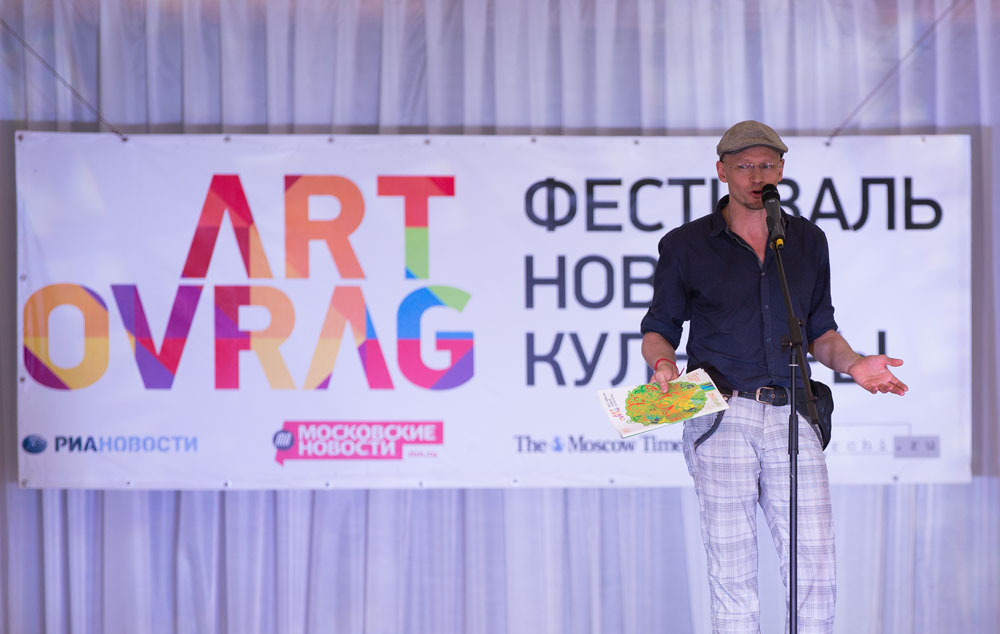
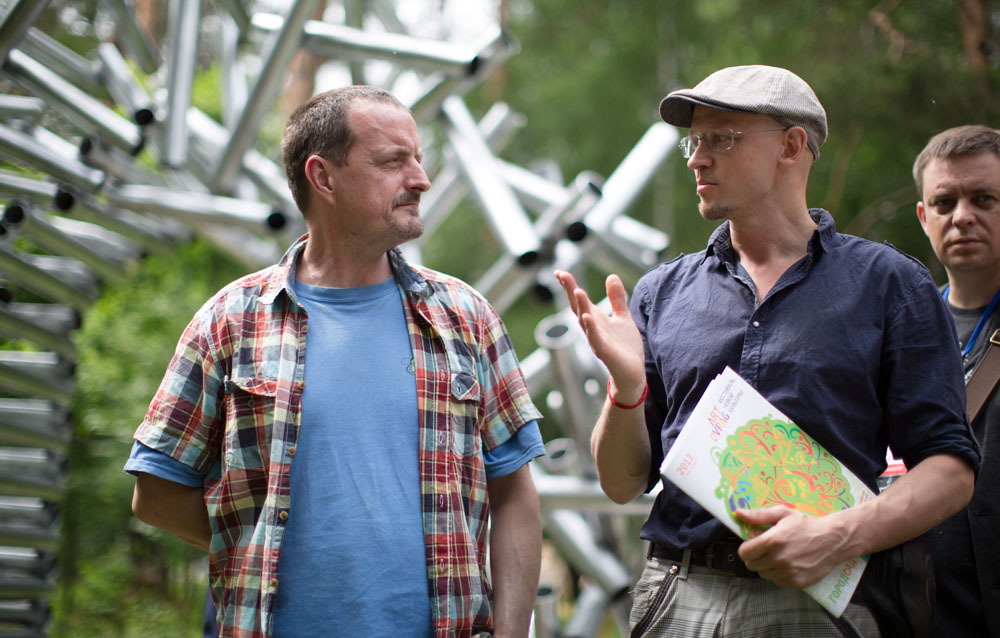
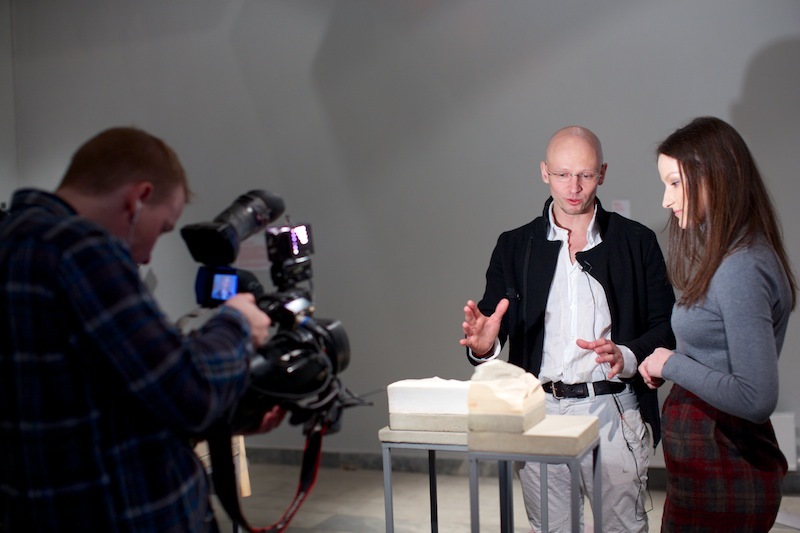
The transition has a date and a work. Circular Ruins (September 2009), after Borges, was the first Art-Residence project and the first time a performance of his was accompanied by an exhibition connected to it only conceptually. What followed was a decade of festivals: No Translations, Architecture. Body. Dance, extension.art; Random Gallery, thirty exhibitions in one unfunded room; Art-Ovrag festival in the steel town of Vyksa, which grew from five to eighteen thousand visitors in a year under his direction; and Kod Epokhi / Zeitgeist project in 2013, built on the idea that an epoch leaves a hieroglyph behind and that the object is the key to reading it. Its motto was 'a world of ideas in a world of things'.
Silence, and What Came After
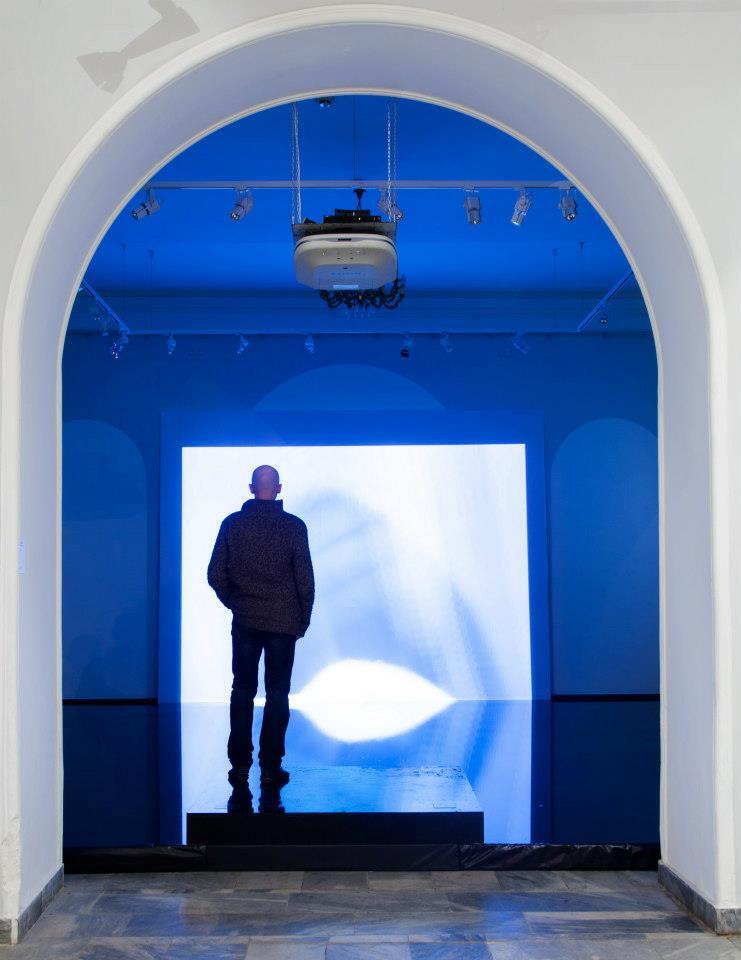
In December 2013, in an empty Venice, he recorded the sound of his own footsteps on a phone. A musician made a composition from it for Quest for Silence, the 2014 exhibition that asked twenty-five artists what silence is. His own answer, printed beside his work: "silence is intrinsic to memory; the further away, the cleaner the general background."
Since then the work has moved steadily towards stillness — the Almost Empty Space videos, the kinetic sculptures in which movement is not depicted but held as a possibility, and Eclipse 4′33″, an action lasting exactly as long as the solar eclipse of 2 July 2019 and exactly as long as Cage's silent piece.
Now
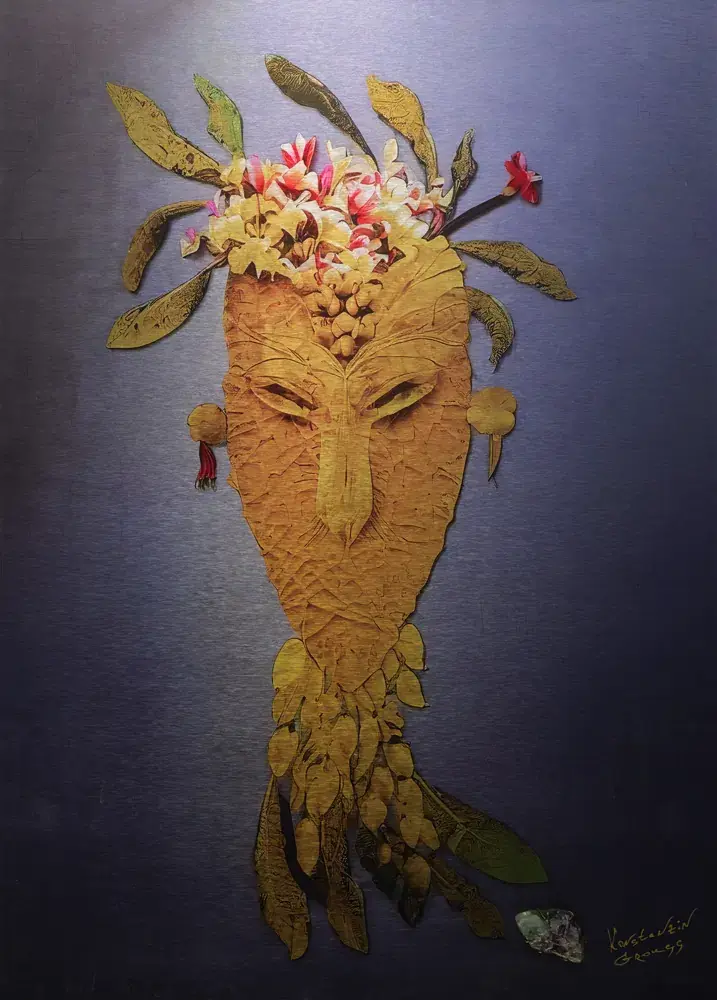
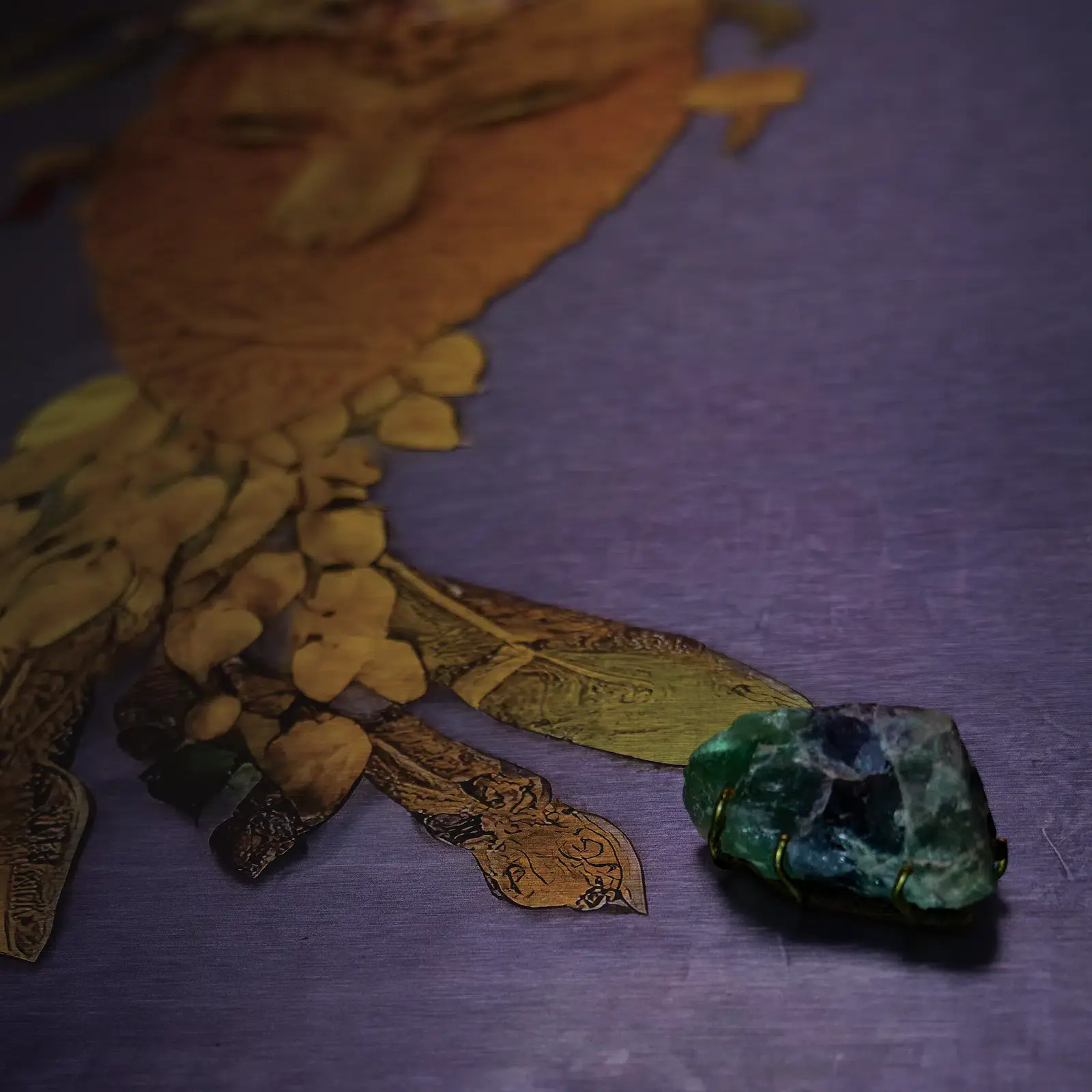
Since 2023 Grouss has lived in Ubud, Bali, where the work begins with leaves, flowers, stones and seeds. A composition is assembled by hand, photographed once, and gone; over months the image is built from it and then returned to aluminium, teak or silk, each of which does something different to it. Last, a crystal is found for each work and fixed to it by hand. He calls the method BaliKu, and the series Extended Moment. The idea is the one he put on stage as an epigraph to "Intuition of Form" twenty-three years ago. ‘...one form may take on another; the reasons for such a change are countless...’
The archive of the earlier practice — choreography, video, sculpture and curatorial projects, 2003–2023 — is on this site. The current work is at grouss.art.
"Dance is precisely the transcendence of the body's boundaries; it reveals possibilities that extend beyond the physical shell. More than any other art form, dance harnesses the body's energy, revealing its hidden potential."
...
"An artist dances whilst painting, and few manage to capture that dance on canvas. Every painting is like a float on the water, from which many threads lead to the deepest origins, sources and themes."
Konstantin Grouss. Interview — «Искра · Spark» — April, 2004
...
"An artist dances whilst painting, and few manage to capture that dance on canvas. Every painting is like a float on the water, from which many threads lead to the deepest origins, sources and themes."
Konstantin Grouss. Interview — «Искра · Spark» — April, 2004
THE THREAD
- Dürer 1528
‘...one form may take on another; the reasons for such a change are countless...’ (Albrecht Dürer, Treatise on Proportions)
- Intuition of Form 2003
dedicated to all that has not found its form
- John Cage music projects 2004
duration, silence, chance
- Notes 2010
dance — contemporary art transition
- Quest for Silence 2014
silence as subject
- Swans Have Arrived! 2018
the sign, standing still for a year
- Extended Moment, Bali 2026
duration of form and moment
In print
-
"Konstantin Grouss is a magnificent dancer and a fascinating choreographer."
Alexei Lubimov — letter of 5 January 2006 — People's Artist of Russia, laureate of the Prize of the City of Moscow, Professor of the Moscow Conservatory
-
"He is certainly not a revolutionary… rather a mathematician-philosopher… Not the architecture of the body, but the architecture of the soul."
Irina Plotnikova — Teatralniy MIR /Театральный МИР/ №11 — November 2010
-
"Grouss's dance is striking. Energy really does matter in it, becoming the second protagonist of the piece."
Anastasia Gladilshchikova — Moskovskie Novosti — 19 March 2013
-
"Il corpo nella corrente di informazioni prende una forma dopo l'altra."
'The body, within the current of information, takes one form after another.'
Il Tirreno, Pisa — 18 November 2016
The Record
A complete catalogue of artistic works, curatorial practice and choreographic works — grouped by medium, ordered in reverse chronology, nothing omitted.
Each group opens on the plus sign in its header and closes again on the same control. Individual entries carry the year or span and the venue, institution or project they belong to.
Artistic Works
2018 "Swans Have Arrived!" — sculpture, performance, video. The Botanic Gardens of Moscow State University "THE APOTHECARIES' GARDEN".
2015 "Absolute synchronicity" — sculpture, performance, video. "Horizontal" project, Moscow Biennale of Contemporary Art.
2023 "Dive Within" — video, dance. 4′43″. Kintamani, Bali.
2020 "A poem at war / Dandelion time" — video, music, poetry, dance. 4′33″.
2020 "Capriccio for violin solo" — music Simeon ten Holt. With OpenSound Orchestra.
2018 "Almost empty space" — series of video. New space of Theatre of Nations, Moscow.
2016 — 17 "Round panorama 13/11" — video, dance. New space of Theatre of Nations.
2015 "Inappropriate texts" — video film / multimedia performance. Marina Tsvetaeva Museum.
2014 "A Property of Memory" — video. Quest for Silence project. Art-Residence, Moscow.
2007 — 11 "The 21st Floor" — video.
2019 "Dance for 8 strings" — contemporary dance, contemporary music performance. Scriabin Museum.
2019 "What is it eaten with" — contemporary dance, performance. Guslitsa creative castle.
2018 "Solo mio, solo duo" — contemporary dance, performance-action. Guslitsa creative castle.
2018 "Aheym" — contemporary dance, video. Rachmaninov Concert Hall of Moscow State Conservatory.
2015 "Inappropriate Texts" — video film / multimedia performance. Marina Tsvetaeva Museum, Moscow.
2015 "Violin Phase (Steve Reich)" — ICQ-Project at the Chamber Hall of the Moscow International House of Music
2014 — 18 «EASY-COME-EASY-GO<at>BODY<dot>MOVE» — interactive dance composition. Garage Museum, Moscow. NavigArte, Pisa. New space of Theatre of Nations.
2013 «INFO<at>BODY<dot>MOVE» — interactive dance composition. "Code of Epoch / Zeitgeist" festival. "Room Room Room" special project at 5th Moscow Biennale of Contemporary Art.
2012 "around the heart in 40 min" — contemporary dance performance. "extension.art-3" festival at "Art-Residence", Moscow.
2011 "Constellations and finger-prints" — dance performance. Rachmaninov Concert Hall of Moscow State Conservatory. "No Translations #2" festival.
2010 "A Little Geometric Progression" — Stage Performance—Dance, Music, and Painting. Extension.art – 1 festival.
2010 "Notes" — contemporary dance performance for 3 dancers. "No Translations" multimedia exhibition.
2009 "Circular Ruins" — dance and music performance for 4 dancers and singer. "Art-Residence" project.
2008 "Cage for Air" — choreographic drama for 3 dancers, piano solo and voice. Theatre of Musical Comedy, Krasnoyarsk.
2008 "Phases of the Moon" — dance performance for 4 dancers and painter. Aktoviy Zal, Moscow.
2007 "Between Earth and Sky" — Dance performance, solo. Aktoviy Zal, Moscow.
2006 "Atmospheric Phenomena" — performance-action. Denis Stewart Studio, Brussels.
2006 "Bacchanalia in the Garden of Stones" — performance for 3 dancers and prepared piano on John Cage music, with pianist Alexei Lubimov.
2006 "mask For body" — dance performance for 4 dancers. Pushkin Museum of Fine Arts, Moscow.
2005 "Philosophy of Walls" — dance piece for 5 dancers. State Theatre of Nations, Moscow.
2003 — 04 "Intuition of Form" — contemporary dance performance. Meyerhold Theatre Centre; THEKH festival, The State Tretyakov Gallery, Moscow.
Curatorial Practice
2015 "Accelerator of New Moscow" — art & science multimedia exhibition, conference №9.
2014 "Quest for Silence" — multimedia exhibition. Contemporary art, music, dance.
2014 — 15 Skolkovo & Varshavka Galleries — exhibition curator / producer of exhibition and residency programmes.
2013 "WHERE VIEWABLE" — multimedia exhibition.
2013 "Code of Epoch / Zeitgeist" — multimedia exhibition. Contemporary art, music, dance, science. Museum of Applied and Folk Art, Moscow.
2011 — 13 "Art-Ovrag" — festival of public art, architecture, street-art, music and dance.
2010 — 11 "no translations" — multimedia exhibition. Contemporary art, music, dance.
2010 — 14 "extension.art" — multimedia exhibition. Contemporary art, music, dance.
2010 — 11 "Architecture-Body-Dance" — multimedia exhibition. Contemporary art, music, dance. Moscow 2010, Basel 2011
2018 "Anthology of contemporary dance in Russia. 21 century. The beginning" — dance performance, united 7 Russian dance companies' works of 2000–2018 into one performance.
2013 "Code of Epoch / Zeitgeist" — multimedia exhibition. Contemporary art, music, dance, science. Museum of Applied and Folk Art, Moscow.
2013 "Room Room Room" — contemporary choreography festival. Special project of the 5th Moscow Biennale of Contemporary Art, international culture project "Art-Residence".
2010 — 11 "Architecture-Body-Dance" — choreographic research and exhibition programme. Cross-disciplinary series on architecture, the moving body and contemporary dance.
2010 — 14 "extension.art" — annual showcase and curatorial platform for Russian contemporary dance, music and visual art. Art-Residence programme.
2010 — 11 "no translations" — multimedia exhibition. Contemporary art, music, dance.
Documents
Three open files: a current CV, a selection of projects in context, and the full source dossier with ninety-five cited sources.
Each file opens in a new tab on click. The whole row is the control — click anywhere on it.
№ 01
Curriculum Vitae
Complete CV — Artistic and curatorial practice, residencies.
№ 02Selected Projects & Context
Twenty years of artistic and curatorial work, with venue and partner context.
№ 03Source Dossier
Ninety-five sources, each with quotation and provenance — the archive behind the record.
CONTACTS
- konstantin.grouss <at> gmail.com
- Current visual work — grouss.art
- Instagram — @konstantingroussart
- International Culture Project
"Art-Residence" — art-residence.ru
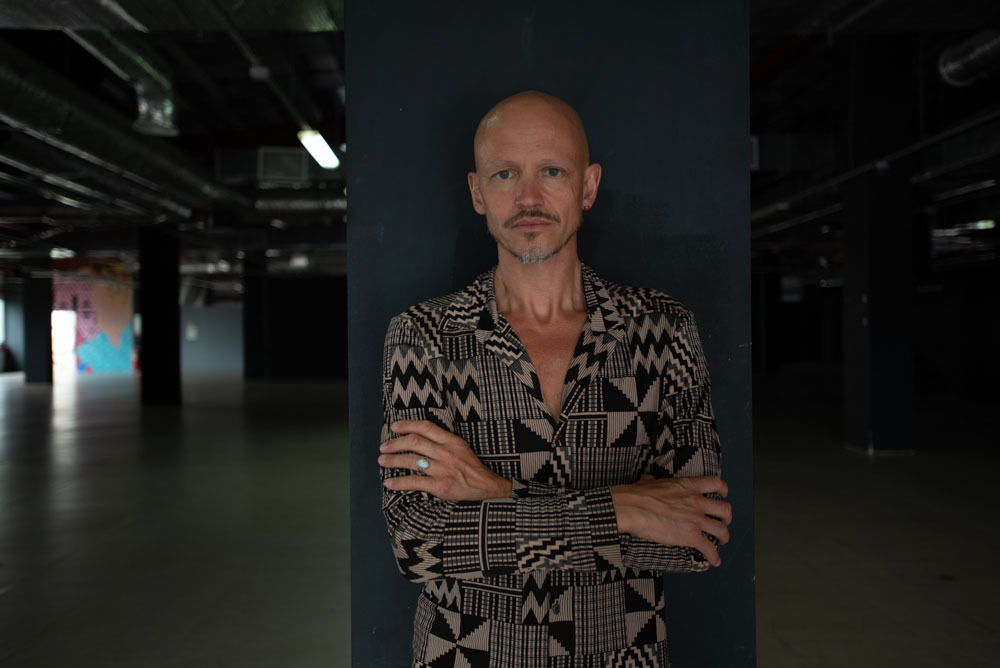
Konstantin Grouss. Photo by Irina Trushina.